How Manufacturers Can Use Local AI to Improve Production Operations
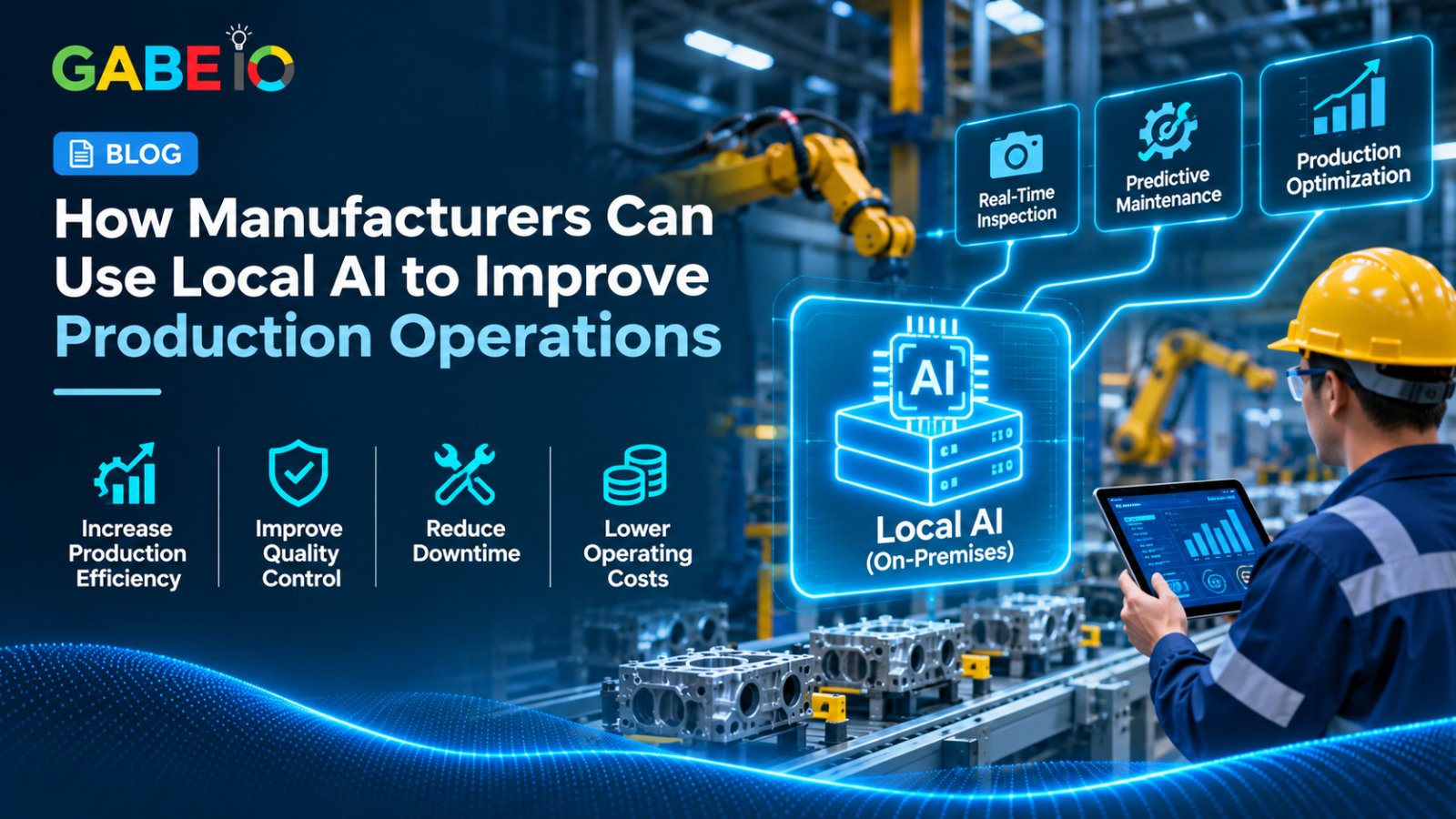
Manufacturing operations generate large amounts of information every day. Production equipment, quality inspection systems, inventory platforms, and operational software all contribute data that can help businesses improve efficiency and make better decisions.
Artificial intelligence provides manufacturers with new ways to analyze this information, identify patterns, automate selected tasks, and support operational decision-making.
However, many manufacturers must also consider where their operational data is processed and how AI applications integrate with existing production environments.
Local AI offers an alternative to relying entirely on externally hosted AI services. By deploying AI models within their own infrastructure, manufacturers can process selected workloads in an environment they control.
This article explores how manufacturers can use local AI to improve production operations, the infrastructure required, and what to consider before deployment.
What Is Local AI in Manufacturing?
Local AI in manufacturing refers to running AI models and applications on computing infrastructure deployed within a manufacturer's own facilities or controlled environment.
Instead of sending every AI request to an external cloud service, an organization can process selected workloads using local workstations or on-premises servers.
These systems can support applications such as:
- Production data analysis.
- Quality inspection support.
- Equipment maintenance analysis.
- Internal operational knowledge retrieval.
- Manufacturing document processing.
- Production reporting and summarization.
The specific applications depend on the AI model, available data, computing infrastructure, and integration with existing manufacturing systems.
Local AI does not automatically replace industrial control systems or specialized machine-vision equipment. It can complement existing manufacturing technologies by providing additional AI capabilities.
1. Improving Production Data Analysis
Manufacturing facilities generate operational data from machines, production lines, sensors, and management systems.
Analyzing this information can help production teams understand operational patterns and identify areas that need attention.
AI applications can assist with:
- Summarizing production reports.
- Identifying patterns in historical production data.
- Comparing production performance across reporting periods.
- Organizing operational records.
- Highlighting unusual trends for further investigation.
For example, a manufacturer could deploy an internal AI assistant that helps production managers search approved production reports and summarize recurring operational issues.
This can make information easier to access without requiring employees to manually review every document.
2. Supporting Quality Control
Quality control is an important part of manufacturing operations.
Defects, inconsistent product specifications, and inspection delays can affect production efficiency and product quality.
AI can support quality-related workflows by helping teams analyze inspection information, organize defect records, and review historical quality reports.
Potential applications include:
- Summarizing quality inspection results.
- Organizing defect reports.
- Comparing quality trends across production batches.
- Supporting analysis of recurring production issues.
- Retrieving relevant inspection procedures.
Computer vision systems can also analyze images captured during inspection processes.
However, visual defect detection requires suitable cameras, image-processing systems, validated models, and integration with the production environment. A general-purpose AI workstation should not be assumed to perform these functions without the appropriate configuration.
3. Supporting Predictive Maintenance
Unexpected equipment failures can interrupt manufacturing operations and affect production schedules.
Predictive maintenance uses operational data to help identify patterns that may indicate equipment deterioration or potential failure.
AI can support this process by analyzing historical maintenance records, equipment data, and other relevant information.
Potential applications include:
- Summarizing equipment maintenance histories.
- Identifying recurring maintenance issues.
- Reviewing equipment performance trends.
- Organizing maintenance documentation.
- Supporting maintenance planning.
For example, an internal AI application could help maintenance teams retrieve previous service records and identify recurring problems associated with a particular machine.
More advanced predictive maintenance systems require reliable sensor data, appropriate analytical models, and validation against actual equipment performance.
4. Making Manufacturing Knowledge Easier to Access
Manufacturing organizations often maintain large collections of operational documentation.
These may include:
- Standard operating procedures.
- Equipment manuals.
- Safety instructions.
- Maintenance records.
- Production guidelines.
- Quality management documentation.
Finding the right information can take time, particularly when employees must search across multiple systems.
A locally deployed AI assistant can connect to approved internal documentation and help employees retrieve relevant information.
For example, an employee could ask:
"What is the approved procedure for inspecting this production component?"
The AI application could retrieve relevant internal documentation and generate a summary for the employee to review.
This can improve access to organizational knowledge while keeping the underlying documents within the manufacturer's controlled environment, subject to the deployment's security configuration.
5. Supporting Production Planning and Reporting
Production managers must coordinate schedules, resources, inventory, and operational priorities.
AI can help organize information and support routine reporting activities.
Potential applications include:
- Summarizing production schedules.
- Preparing operational report drafts.
- Comparing production targets with recorded results.
- Organizing inventory-related documentation.
- Extracting information from internal reports.
- Supporting planning discussions.
AI-generated recommendations should be reviewed by qualified employees before they influence production decisions.
The goal is to support operational teams, not remove the need for human oversight.
Why Manufacturers May Choose Local AI
Manufacturers considering AI deployment must evaluate not only what AI can do but also where their information is processed.
Local AI can offer several operational advantages.
Greater Control Over Operational Data
Manufacturing data can include production records, product specifications, equipment information, and confidential operational processes.
Running selected AI workloads locally can reduce the need to transfer this information to external AI services.
Organizations retain greater direct control over the environment in which those workloads operate.
Reduced Dependence on External AI Services
Local deployment gives manufacturers another option when external connectivity, service availability, or third-party usage policies are important considerations.
Some workloads may operate entirely within internal infrastructure, depending on their software and integration requirements.
Integration with Internal Systems
Local AI applications can be designed to work with approved internal data sources and business applications.
This may include production reports, document repositories, maintenance records, and other operational systems.
Integration must be properly designed and tested to ensure that AI applications retrieve accurate information and respect existing permissions.
More Control Over AI Infrastructure
Manufacturers can determine which hardware, models, applications, and data sources are used within their AI environment.
This can help technology teams establish consistent deployment, access, and monitoring policies.
What Infrastructure Is Required for Local AI in Manufacturing?
Running AI locally requires suitable hardware and software infrastructure.
The right configuration depends on the intended application and the size of the workloads.
1. AI Computing Hardware
AI workloads may require GPUs and sufficient system memory to process models efficiently.
Manufacturers should evaluate:
- GPU architecture and computing capability.
- Available memory.
- CPU capacity.
- Storage capacity and performance.
- Network connectivity.
- Power and cooling requirements.
An AI workstation may be appropriate for focused inference applications, while larger or more demanding workloads may require GPU servers.
2. AI Models and Software
The software stack depends on the applications being deployed.
It may include:
- Language models.
- Model-serving frameworks.
- AI inference software.
- Computer vision frameworks.
- Retrieval-augmented generation tools.
- AI orchestration platforms.
- Application integration tools.
Manufacturers should verify software compatibility and licensing before selecting their infrastructure.
3. Data Storage and Connectivity
AI applications need access to the information they are expected to process.
This may include production reports, maintenance records, inspection images, and operational documentation.
Storage and networking should be designed around data volume, application performance, access requirements, and security policies.
4. Security and Access Controls
Local AI infrastructure must be protected.
Manufacturers should implement:
- Role-based access control.
- Authentication and authorization.
- Encryption.
- Network segmentation.
- System monitoring.
- Activity logging.
- Data retention policies.
- Regular software updates.
Employees should only be able to retrieve information they are authorized to access.
How to Start a Local AI Deployment in Manufacturing
Manufacturers should begin with a clearly defined operational problem rather than selecting hardware first.
Step 1: Identify a Suitable Use Case
Identify a repetitive or information-intensive process where AI could provide measurable value.
Examples include production report summarization, maintenance documentation retrieval, and quality inspection analysis.
Step 2: Identify the Required Data
Determine which records, documents, images, or operational datasets the application needs.
Evaluate data quality, availability, ownership, and access permissions.
Step 3: Define the Technical Requirements
Determine the model, workload, expected number of users, memory requirements, processing capacity, and software dependencies.
Step 4: Select the Infrastructure
Evaluate whether an AI workstation or GPU server is appropriate.
Consider the expected workload, future expansion, power, cooling, storage, and deployment environment.
Step 5: Configure Security and Integration
Establish access controls and connect the AI application to approved internal information sources.
Test the system to confirm that users can only retrieve authorized information.
Step 6: Run a Pilot
Begin with a limited deployment and measure:
- Accuracy and output quality.
- Processing time.
- User adoption.
- Infrastructure utilization.
- Operating costs.
- Impact on the selected operational process.
Use these results to determine whether the application should be expanded.
How GabeHERO TX Supports Local AI in Manufacturing
Manufacturers evaluating local AI need infrastructure that can run selected AI inference workloads within their own environment.
GabeHERO TX is a local AI inference workstation designed to bring enterprise AI computing inside an organization's facilities.
Its published specifications include:
- NVIDIA Jetson Thor T5000.
- Blackwell architecture.
- 128GB unified memory.
- Up to 2,070 TFLOPS of FP4 inference performance.
- Support for 70B–120B parameter model workloads, subject to model configuration and deployment requirements.
For manufacturing organizations, GabeHERO TX can provide a platform for evaluating local AI applications such as:
- Internal production knowledge assistants.
- Manufacturing document analysis.
- Maintenance report summarization.
- Operational information retrieval.
- Selected AI inference applications.
The suitability of each workload should be confirmed through technical testing, including model compatibility, software requirements, memory capacity, and application performance.
GabeHERO TX is an AI inference workstation. It should not be presented as a replacement for industrial controllers, PLCs, or specialized real-time machine-control systems.
Frequently Asked Questions
What is local AI in manufacturing?
Local AI in manufacturing means running AI models and applications on computing infrastructure deployed within a manufacturer's own environment rather than relying entirely on external AI services.
How can AI improve manufacturing operations?
AI can support production data analysis, quality-related workflows, maintenance documentation, internal knowledge retrieval, and operational reporting. The benefits depend on the application and quality of the underlying data.
Can manufacturers run AI without using the cloud?
Yes. Selected AI workloads can run locally without sending their inference requests to external AI services, provided the models, software, and supporting infrastructure are configured for local operation.
Can local AI support predictive maintenance?
Yes. Local AI applications can help analyze maintenance records and operational data. Reliable predictive maintenance requires suitable sensor data, validated models, and integration with equipment-monitoring systems.
Can AI help with manufacturing quality control?
AI can support quality inspection through document analysis, image processing, and defect-related data analysis. Visual inspection requires appropriate camera systems, computer vision software, and validated models.
What hardware is needed to run AI in a manufacturing facility?
Hardware requirements depend on the AI application, model size, memory requirements, and number of concurrent users. Options may include AI workstations and GPU servers.
Is local AI suitable for manufacturing facilities with limited internet connectivity?
Some local AI applications can operate without continuous external connectivity. However, software dependencies, updates, integrations, and licensing requirements should be reviewed before deployment.
Conclusion
AI gives manufacturers new ways to analyze operational information, support employees, and improve selected production workflows.
Local AI provides an additional deployment option for organizations that want greater control over where their AI workloads run and how internal information is processed.
Successful implementation requires the right use case, suitable computing infrastructure, secure data access, compatible software, and proper testing.
With GabeHERO TX, Gabe IO provides a local AI inference workstation option for manufacturers exploring enterprise AI applications within their own environments.
Ready to explore local AI for your manufacturing operations? Use the Request More Information button below and we will get back to you within one business day.