Why enterprise AI is moving back inside the walls
The first wave of enterprise AI ran almost entirely in the cloud. That made sense: a cloud API is the fastest way to find out whether a model can help with a task, and nobody wants to buy hardware for an experiment.
But pilots and production are different things. Once AI moves from a demo to a workflow that runs every hour of every day, three questions start to dominate the conversation: what it costs, where the data goes, and what happens when the connection drops. For a growing number of teams, the answer to all three is the same: run inference on-premises.
The meter never stops
Cloud AI is priced per use. Every query, every document processed and every step an AI agent takes is metered. That is cheap while usage is small, and it is exactly why costs become hard to predict later.
Agent workflows make this sharper. A single business task, such as reviewing a contract or checking an inspection report, can trigger many model calls behind the scenes. The more useful the system becomes, the more it gets used, and the bigger the bill. Success turns into a recurring cost that grows with it.
On-premises inference flips that model. The hardware is a one-time investment, and running one more query costs almost nothing. Teams can let AI handle more work without first asking whether the budget can absorb it.
Your data stays where it already lives
The documents that make AI valuable are usually the ones a company is most careful with: contracts, financial records, customer files, engineering drawings, production images. Sending them to a cloud model means routing them through infrastructure the company does not control, often across several jurisdictions.
When the model runs on your own hardware, inside your own network, that question disappears. Data never leaves the building. Security reviews get simpler, because the answer to "where does this data go?" is "nowhere". And it holds by design, not because a vendor contract says so.
AI that keeps working when the internet does not
Factory floors, warehouses and branch offices do not always have perfect connectivity. A cloud outage, a network fault or a slow link can stop an AI-assisted process in its tracks.
Local inference removes that dependency. A system that runs fully offline keeps working through outages, with no single point of failure outside your control. For operations that cannot pause, that matters more than any benchmark.
What changed: the hardware caught up
A few years ago, running a capable model on-premises meant a server room and a dedicated team. That is no longer true.
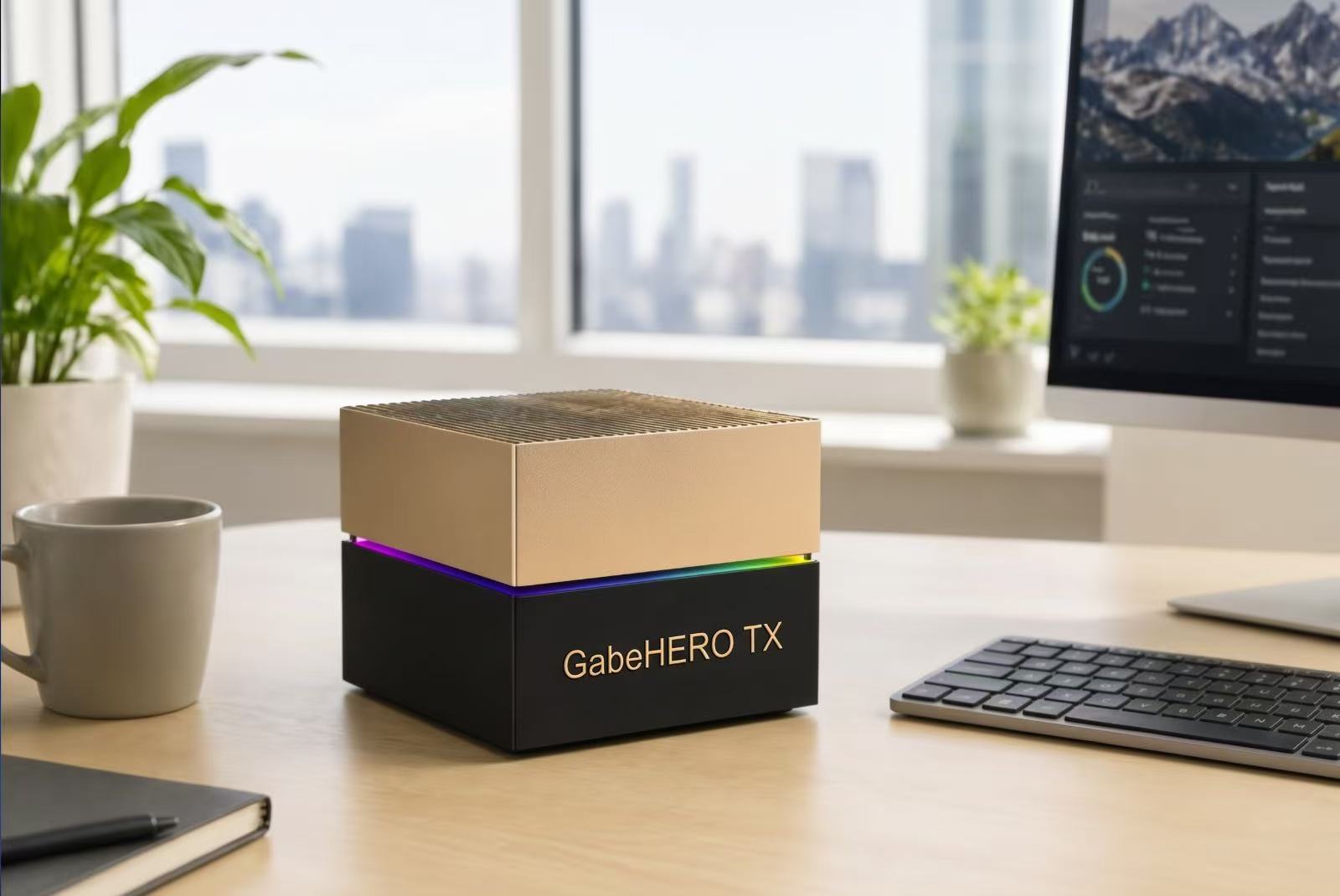
Today a single workstation can run models in the 70 to 120 billion parameter range: leading open models, governed by the enterprise that runs them. Our GabeHERO TX delivers 2,070 TFLOPS of AI inference in a desktop form factor, arrives pre-configured, and is ready for production without a complex setup.
When the cloud still makes sense
On-premises is not the answer to every question. Cloud AI remains a good fit for early experiments, for occasional workloads, and for tasks where data sensitivity is low. Many organizations will use both.
The shift is about the workloads that matter most: the ones that run constantly, touch sensitive data, or cannot afford to stop.
Questions to ask before you decide
- How many model calls will this workflow make per month once it is in full production, and what will that cost in two years?
- What data will the model see, and who is allowed to see that data today?
- What happens to the process if the internet connection drops for an hour?
- Who needs to audit the system's decisions, and can they do that if the model runs somewhere else?
If the answers point toward cost you cannot predict, data you cannot let go of, or uptime you cannot compromise on, it is worth evaluating local inference now, while you still have the freedom to choose your architecture.
The best time to decide where your AI runs is before it becomes critical infrastructure.
Want to see what on-premises AI would look like for your team? Use the Request More Information button below and we will get back to you within one business day.