How Financial Institutions Can Deploy Private Generative AI
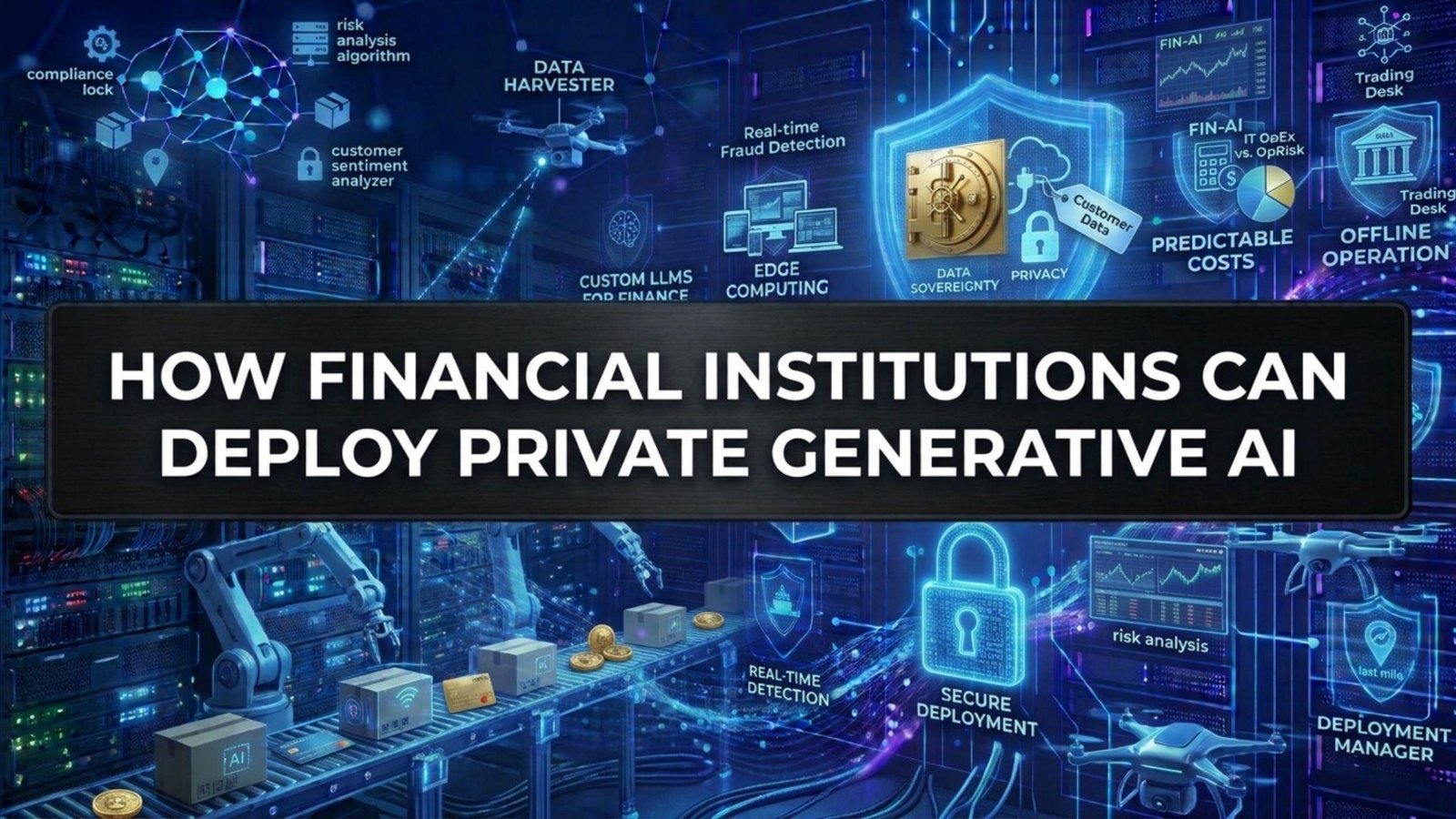
Private AI for financial services means running generative AI models on infrastructure the institution controls, such as an on-premises AI system or a dedicated private cloud, so customer records, transaction data, and internal models never pass through a shared public AI service. It lets banks, insurers, and asset managers adopt generative AI while keeping data protection, model governance, and oversight in their own hands.
Financial institutions hold some of the most sensitive data in the economy: account records, transaction histories, credit files, trading strategies, and internal risk models. At the same time, they face growing pressure to adopt generative AI in banking, insurance, and asset management for research, customer service, compliance, and operations.
Public AI services offer speed and convenience, but institutions must carefully evaluate how customer data, confidential business information, and regulated records are processed by external providers. Private AI for enterprise offers an alternative by placing AI on infrastructure the organization controls.
This guide explains the key considerations for deploying private generative AI in financial services, from selecting use cases and designing the architecture to managing model risk and planning a phased rollout.
Why Private AI Fits Financial Services
Financial institutions have several requirements that make private AI infrastructure an important option for sensitive workloads:
- Confidentiality obligations: Institutions must protect customer and transaction data under applicable laws and regulations, including the Gramm-Leach-Bliley Act (GLBA) in the United States and the General Data Protection Regulation (GDPR) in the European Union.
- Third-party risk management: Institutions need to understand, manage, and maintain appropriate control over technology providers. U.S. banking agencies have issued interagency guidance on third-party risk management that is relevant to relationships involving AI services.
- Model risk management: Supervisory guidance, including the Federal Reserve and OCC guidance commonly known as SR 11-7, emphasizes model documentation, validation, and ongoing monitoring. These principles are relevant when generative AI supports or influences business decisions.
- Data residency: Applicable rules or institutional policies may restrict where customer information can be stored and processed.
- Operational resilience: Critical financial services need continuity plans that account for provider outages, infrastructure failures, and other disruptions.
A private AI deployment helps institutions address these requirements by keeping models, data, and operations within a defined environment under their control. (For the basics of how this works, see What Is Private AI Inference?) However, deploying an on-premises AI system does not automatically establish regulatory compliance. Institutions must still implement appropriate governance, security controls, documentation, and monitoring.
Private AI Use Cases in Financial Services, by Risk Tier
Not every financial services AI application carries the same level of risk. Before deploying a private large language model (LLM), institutions should classify use cases by their potential impact, the sensitivity of the data involved, and the controls required.
| Use case | Typical data | Indicative risk tier | Core controls |
|---|---|---|---|
| Internal knowledge assistant | Policies and procedures | Lower | Access control, source citations, document freshness |
| Analyst research and document summarization | Research reports, filings, internal notes | Lower to moderate | Permission checks, source verification |
| Developer and IT assistance | Source code and configurations | Moderate | Secrets handling, code review, outbound data controls |
| Customer service assistance for staff | Customer records and account information | Moderate | Authentication, data minimization, logging |
| Onboarding and KYC document processing | Identity documents and financial statements | Higher | Human review, accuracy testing, audit trails |
| Compliance monitoring and surveillance support | Communications and transaction data | Higher | Explainability, validation, regulatory review |
| Credit decisioning or pricing support | Credit files and applicant data | Highest | Fair lending review, model validation, explainability, regulatory approval |
Applications that affect customers directly, such as creditworthiness assessments, need particularly careful evaluation. Confirm the applicable classification and obligations with legal counsel.
A practical approach is to begin with lower-risk applications that deliver visible value, such as an internal knowledge assistant. This lets the institution establish its AI governance, security, and evaluation processes before expanding into more consequential use cases.
Reference Architecture for Private Generative AI
A secure private generative AI deployment needs more than a model server behind a firewall. It needs a control layer that governs how employees and applications access data, retrieve information, use models, and act on generated outputs. A typical architecture includes:
- Identity and access gateway: Authenticates requests, checks user roles, applies rate limits, scans for sensitive information, and classifies requests.
- Permission-aware retrieval: Retrieves documents only when the requesting user has permission to access them.
- Private model serving: Hosts an approved model version in an on-premises environment or dedicated private cloud.
- Output controls: Applies citation requirements, redaction, policy filters, and human approval where necessary.
- Audit and monitoring: Records relevant activity and supports model evaluation, incident response, and ongoing oversight.
Four design principles for private AI in banking and finance
- Enforce permissions during retrieval. The model should receive only documents the requesting user is authorized to see. Instructions in a prompt are not a substitute for technical access controls, because prompt injection can cause a model to disclose information it has been given.
- Pin model versions. Uncontrolled model changes can undermine prior validation. Document, test, and approve each production model version before deployment.
- Keep humans involved in consequential decisions. Employees should review AI-generated customer communications before sending them when policy requires it. Recommendations that could affect credit decisions need documented review and the controls required by institutional policy and applicable regulation.
- Maintain audit logs and govern them carefully. Record who made a request, which sources were retrieved, which model version responded, and what action followed. Because logs can contain sensitive information, define access permissions, retention periods, and redaction rules.
These principles help organizations build private AI infrastructure that supports accountability, data protection, and operational oversight.
AI Model Risk Management for Generative AI
Financial institutions should evaluate generative AI systems under an appropriate model risk management framework whenever their use falls within its scope. Documentation should cover:
- Purpose and scope: The business processes the model supports, its intended users, and the limits of its use.
- Model selection: The reasons for selecting the model, its license, provenance, and known limitations.
- Evaluation: Performance on representative institutional tasks, including failure modes and hallucination rates measured against approved sources.
- Independent validation: Review by qualified personnel who were not responsible for building the system.
- Ongoing monitoring: Performance checks, drift monitoring, periodic reevaluation, and defined triggers for revalidation.
- Change control: Documented processes for changes to models, prompts, retrieval sources, and system configurations.
Generative AI is harder to validate than many traditional models because its outputs are open-ended. Build evaluation datasets that reflect actual workflows, cover adversarial examples, and measure whether outputs are accurate and grounded in approved sources.
A private LLM for financial services should therefore be evaluated not only on general benchmarks but on how reliably it handles the institution's own documents, terminology, policies, and business processes.
Data Protection and AI Privacy Controls
Private AI for enterprise requires the same disciplined data governance expected of any system that processes customer information. Recommended controls include:
- Classify data before use: Define which data categories may be used for retrieval, fine-tuning, and logging.
- Minimize sensitive information: Include only the fields needed for a task and mask identifiers where practical.
- Apply data loss prevention: Scan requests and outputs for account numbers, national identifiers, payment card information, and other sensitive data.
- Encrypt data: Protect information in transit and at rest, with encryption key management under appropriate institutional control.
- Limit logging of prompts: Restrict stored prompt content, or redact sensitive fields before saving logs.
- Manage retention and deletion: Account for stored documents, indexes, embeddings, and other artifacts derived from customer data.
Payment card information also falls within the scope of PCI DSS where applicable, and systems that process it need the controls that standard requires.
A private deployment gives an institution greater control over its data environment, but the effectiveness of that control depends on the complete system design, operating procedures, and access policies.
Security, AI Agent Governance, and Operational Resilience
An on-premises AI system should receive the security protections expected of any other critical enterprise system. Financial institutions should:
- Segment the AI environment from general networks and deny outbound connections by default where appropriate.
- Restrict administrative privileges and require strong authentication for operators.
- Patch the operating system, drivers, model runtime, and retrieval components on a documented schedule.
- Test for prompt injection, unauthorized document retrieval, and data exfiltration through connected tools.
- Establish failover and recovery procedures and test them regularly.
- Define recovery objectives for AI services that support critical business processes.
AI agent security
Institutions deploying AI agents should also assess AI agent security. Agents that can call tools, access internal systems, or initiate actions create risks beyond those of a text-generation model. Apply least-privilege permissions, restrict available tools, and require approval for sensitive or consequential actions.
AI agent governance should define who can deploy agents, which systems they may access, what actions they can perform, and how their behavior is monitored.
Third-Party Risk Management for Private AI
Private AI does not eliminate third-party dependencies. Financial institutions may still rely on hardware suppliers, software vendors, model providers, and implementation partners. Apply third-party risk management to each relevant relationship, including:
- Due diligence on security controls, financial stability, and regulatory standing.
- Contract terms covering data handling, audit rights, subcontractors, incident notification, and exit assistance.
- A documented exit strategy covering models, configurations, data, and operational procedures.
Classify every workload before deployment, and do not send restricted information to any external service without explicit authorization. The right deployment model depends on the institution's data sensitivity, regulatory obligations, workload requirements, existing infrastructure, and operational capabilities. For how to design for vendor independence, see Sovereign AI Infrastructure: Benefits, Architecture, and Deployment.
How to Roll Out Private AI in Financial Services: 5 Phases
A phased implementation lets institutions establish controls before expanding the scope of AI deployment.
Phase 1: Establish governance (weeks 1–4)
Create an AI governance committee with representatives from risk, compliance, legal, technology, and business teams. Define the AI use policy, establish risk tiers, and assign model owners.
Phase 2: Pilot a lower-risk use case (weeks 5–12)
Deploy an internal knowledge assistant on a private AI infrastructure stack. Build an evaluation dataset, complete a security review, and document the model under the institution's framework.
Phase 3: Harden and validate (weeks 13–20)
Complete independent validation, finalize logging and retention rules, test failover and recovery, and train users on acceptable use and the limits of AI-generated content.
Phase 4: Expand by risk tier (months 6–12)
Introduce additional use cases using the controls established during the pilot. Advance higher-risk applications only after the required validation and regulatory reviews are complete.
Ongoing: Monitor and reassess
Track adoption, output quality, incidents, and model performance. Repeat evaluations on a defined schedule and whenever a material change occurs in the model, data, or use case.
These timeframes are illustrative. Actual schedules depend on the institution's governance processes, technical readiness, and approval requirements.
Common Pitfalls to Avoid
- Starting with high-stakes use cases. Launching a credit-related AI application before governance and validation processes exist creates unnecessary risk. Begin with lower-risk workflows and expand systematically.
- Treating the model as the only security control. Model behavior matters, but access control, data protection, audit logging, and human review are equally important parts of a secure deployment.
- Relying only on public benchmarks. General benchmark results do not show how well a model handles an institution's policies, products, or customer language. Test it against representative internal tasks.
- Ignoring employee needs. Employees may turn to unapproved AI tools if sanctioned alternatives do not meet their needs. Provide an approved solution and train users on its appropriate use.
- Letting a pilot become production by default. Define production-readiness criteria in advance, including validation, change control, monitoring, security approval, and operational ownership.
Private AI Readiness Checklist for Financial Institutions
Before expanding a private generative AI deployment, confirm that the institution has:
- Established an AI governance committee with clear decision-making responsibilities.
- Classified AI use cases by risk and defined the relevant controls and approval paths.
- Mapped applicable regulatory obligations with legal counsel.
- Selected a deployment model and documented data residency requirements.
- Tested access permissions throughout the retrieval process.
- Documented, pinned, and validated model versions before production use.
- Built evaluation datasets using representative institutional tasks.
- Implemented data loss prevention controls for requests and outputs.
- Approved logging, retention, and access rules for AI records.
- Reviewed vendor contracts for data handling, audit rights, incident notification, and exit assistance.
- Tested incident response, failover, and recovery procedures.
- Trained users to verify AI outputs and escalate issues appropriately.
Frequently Asked Questions About Private AI for Financial Services
What is private AI for financial services?
Private AI for financial services refers to AI systems deployed in environments where the institution can establish and manage appropriate controls over data access, model use, and operations. Depending on the requirements, deployment may use on-premises infrastructure or a dedicated private cloud.
Can a bank use generative AI on customer data?
Yes, provided the data handling, access controls, and model governance meet applicable legal and regulatory requirements. Institutions should confirm their specific obligations with counsel and evaluate each use case individually.
Which private AI use cases should a bank start with?
Start with lower-risk, internal use cases such as a knowledge assistant for policies and procedures or summaries of analyst research. They deliver visible value while the institution builds its governance, security, and evaluation processes, before moving on to customer-facing or credit-related applications.
Does private deployment automatically satisfy regulators?
No. Private deployment can support data control and compliance evidence, but it does not replace governance, validation, documentation, security, and monitoring. Regulatory expectations depend on the use case, jurisdiction, and applicable rules.
How should financial institutions validate a private LLM?
Build an evaluation dataset from representative institutional tasks. Measure accuracy and grounding against approved sources, test failure modes and adversarial inputs, and have qualified independent personnel review the results. Repeat validation after material changes.
Should a financial institution use an open-weight or licensed AI model?
Either may be appropriate. Evaluate license terms, model provenance, vendor support, security update commitments, and suitability for the intended tasks. Document the rationale for the selection.
What should an institution do if an employee pastes customer data into an unapproved public AI tool?
Treat the incident according to the institution's security and incident response policies. Assess the potential exposure, notify the appropriate parties under established procedures, and provide a sanctioned alternative that meets the employee's needs.
Building a More Controlled Enterprise AI Environment
Deploying generative AI in financial services takes more than selecting a capable model. Institutions need a coordinated approach to data protection, model risk management, AI agent security, operational resilience, and governance.
A private AI infrastructure strategy helps organizations establish greater control over sensitive workloads while introducing generative AI in a measured, accountable way. The most effective starting point is a clearly defined business use case, a deployment architecture suited to the institution's requirements, and a governance framework that can scale as adoption grows.
Gabe IO helps organizations explore private and on-premises AI deployment approaches designed around their data, infrastructure, and operational requirements.
Interested in evaluating private AI for your organization? Tell us about your AI workloads and data requirements, and we will show you what could run on-premises and whether GabeHERO TX is the right fit.
[Request More Information]
This article is a practical overview, not legal advice. Regulatory obligations vary by jurisdiction and charter, so involve your legal, compliance, and model risk teams from the start.